

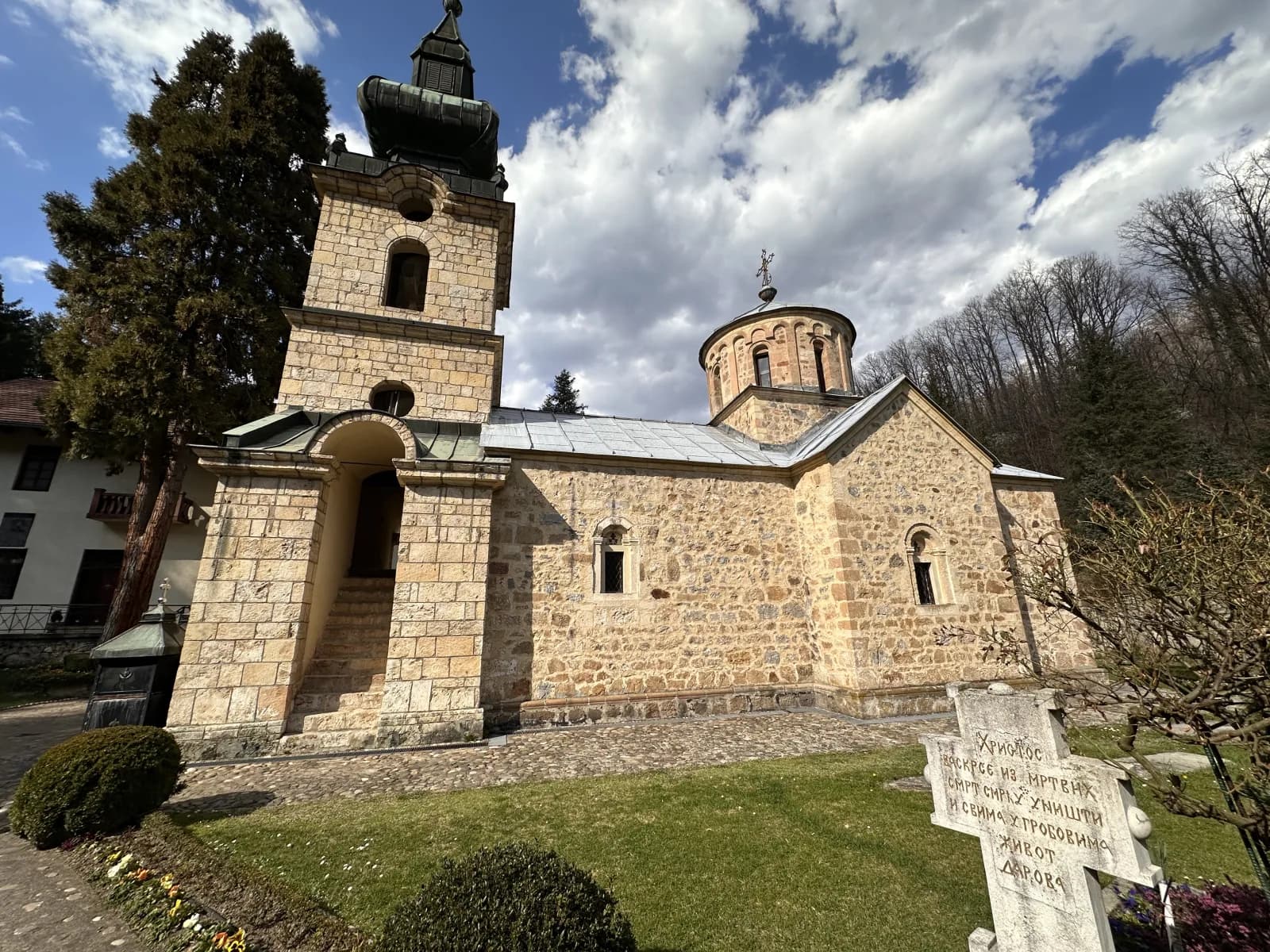
Set amid the green landscape not far from Tršić, Tronoša has preserved traces of the spiritual, cultural and educational life of the Serbian people for more than seven centuries.
When you leave Vuk’s Tršić and head towards Tronoša Monastery, the road takes you through the Jadar region, towards the village of Korenita.
There, on the slopes of Mount Tronoška, where fresh air and mountain streams meet, stands one of the most important Nemanjić-era sanctuaries in this region—a church dedicated to the Presentation of the Holy Virgin, captivating visitors with its architectural beauty and immeasurable importance to the Serbian people.
Tronoša is part of a wider spiritual landscape that, during the reign of King Dragutin Nemanjić, connected the lands on both sides of the Drina. Dragutin built sanctuaries throughout this area—including Rača near Bajina Bašta, and, in present-day Republika Srpska, Papraća, Tavna, Lovnica and Ozren. Towards the end of his life, he also began the construction of Tronoša.
King Dragutin died in 1316, and a year later the monastery was completed by his wife, Queen Katalina. Thus, in 1317, one of the sanctuaries that would become much more than a place of prayer over the centuries was completed.
The Tronoša Triptych: Spirituality, History and Literacy
Tronoša is not only a place of prayer; it is a historical and cultural monument where three elements intertwine:
A Sanctuary of Community and Literacy: It was within these stone walls that Vuk Stefanović Karadžić took his first steps in education, before becoming a reformer of the Serbian language and script and one of the most important figures in Serbian cultural history.
For this reason, Tronoša is not merely a place connected to one era of Serbian medieval history. Its story continues through Vuk’s childhood and education, giving the monastery a special place in the history of Serbian literacy.
Architecture Embraced by Nature: the massive stone walls, slender lines and white façade of the monastery church dedicated to the Presentation of the Holy Virgin, set against the dense green of the surrounding forest, create a scene filled with dignity and tranquillity.
The Fountain of the Nine Jugović Brothers: in front of the monastery complex stands the Fountain of the Nine Jugović Brothers, beside which a chapel was built. According to folk tradition, the fountain was built by Jug Bogdan and his nine sons before they left for the Battle of Kosovo.
Spring water still flows from its ten spouts today, and the site has become one of Tronoša’s most recognisable symbols. Alongside the historical facts about the monastery, traditions such as this form part of the living folk memory associated with this sanctuary.
The Scriptorium and the Tronoša Genealogy
For centuries, Tronoša was also a place where the written word was preserved and passed on. The monastery housed an important scriptorium, where monks copied books and preserved manuscripts, contributing to the preservation of cultural and spiritual heritage.
Tronoša is also associated with the famous Tronoša Genealogy, one of the important monuments of early Serbian historiography. The genealogy was copied by Hieromonk Josif Tronošac in 1791, based on an older manuscript.
The fate of the genealogy is also part of the history of the monastery itself. During the First World War, Austrian forces took valuable treasures from Tronoša, among them the Tronoša Genealogy.
Despite numerous efforts and diplomatic initiatives to return the Tronoša Genealogy to its place of origin, the original work is still kept in Vienna, while several copies have been preserved in Serbia.
The manuscript bears witness to a time when monasteries were among the most important places for preserving books, historical memory and literacy. In this sense, Tronoša was much more than a place of worship—it was one of the places where awareness of one’s own past was preserved.
A Sanctuary That Survived Destruction
Like many Serbian sanctuaries, Tronoša has paid a heavy price for its longevity.
Following the Battle of Kosovo and the arrival of the Ottomans, the monastery was destroyed and left in ruins.
It was restored in 1599, only to suffer destruction again at the beginning of the 19th century, when the Turks set it on fire and destroyed its roof. It remained in ruins until 1834, when it was restored once again during the reign of Prince Miloš Obrenović.
The frescoes were painted by Mihailo Konstantinović from Bitola and Nikola Janković from Ohrid, while a Baroque-style bell tower was added to the church at that time.
But even then, Tronoša was not destined to remain untouched.
During the First World War, the monastery housed a shelter for wounded Serbian soldiers. Many of them died there and were buried in the monastery grounds, among them Captain Dušan Šikonarija of the First Drina Division and Lieutenant Žarko Diković.
Because of the assistance the monastery provided to the Serbian army, Austrian forces looted it and took away its valuables. The monastery’s abbot at the time, Archimandrite Tihon Ivančević, was also killed.
Another Destruction, Then a New Restoration
The Second World War brought further destruction.
On October 12, 1941, a German punitive expedition arrived at Tronoša. Valuables were taken away, while everything that remained was gathered inside the church and set on fire. The interior of the church burned, the frescoes darkened with soot, and the monastery residence was burned and destroyed.
Once again, the sanctuary was left in ruins.
A new chapter in its history began with the arrival of Father Antonije Đurđević as abbot in 1961. Together with his brotherhood and with the support of the faithful, he began the restoration. By 1964, a new monastery residence had been built and other monastery buildings had been restored, along with the Chapel of Saint Great Martyr Panteleimon—the famous Fountain of the Nine Jugović Brothers.
The Institute for the Protection of Cultural Monuments in Belgrade worked on cleaning and restoring the frescoes without adding new paint, allowing them to be preserved in their original form.
What was lost over the centuries to fires and destruction was restored through the efforts of people who returned to their sanctuary. That is why the history of Tronoša is not merely a story of suffering, but also of its continuous renewal.
Farmers’ Candles – A Tradition That Endures
Even today, when many pages of history have been left behind, Tronoša preserves a custom that connects the past with the present.
Tronoša is also known today for a distinctive folk tradition of making large farmers’ or ploughmen’s candles.
In the days before Easter, two large candles are made from pure beeswax, each weighing around 50 kilograms and standing approximately one and a half metres tall. On Holy Thursday, the faithful carry them in a procession to the monastery, where they are placed before the icons of Christ and the Holy Virgin. The custom is associated with prayers for health, a good harvest and the protection of crops.
The candles are then lit during services, on Sundays and on major religious holidays, until the following Easter, when they are replaced with new ones. Traditionally, some of the wax remaining from the previous candles is added to the new ones, so each new candle carries within it a part of those that came before.
Thus, faith, memory and community life continue to meet at Tronoša. What once began in the monastery school, continued in the scriptorium and survived through turbulent centuries of history now also lives on through traditions passed down from one generation to the next.
That is why you do not leave Tronoša with merely an image of an old sanctuary.
You leave with the feeling that this is a place where history has not remained locked inside books. It is still present—in the silence of the monastery courtyard, in the water flowing from the old fountain, in the books once copied by monks and in the flame of the great farmers’ candles.
