

A Guide to the Works of the Writer Who Turned the History of Our Lands into Great Literature
Few writers have had their books so deeply connected to the places from which they emerged as Ivo Andrić.
In his stories and novels, centuries, empires, states and different faiths come and go, but at the centre of it all remains the human being—with his fears, hopes, weaknesses and eternal need to understand the world in which he lives.
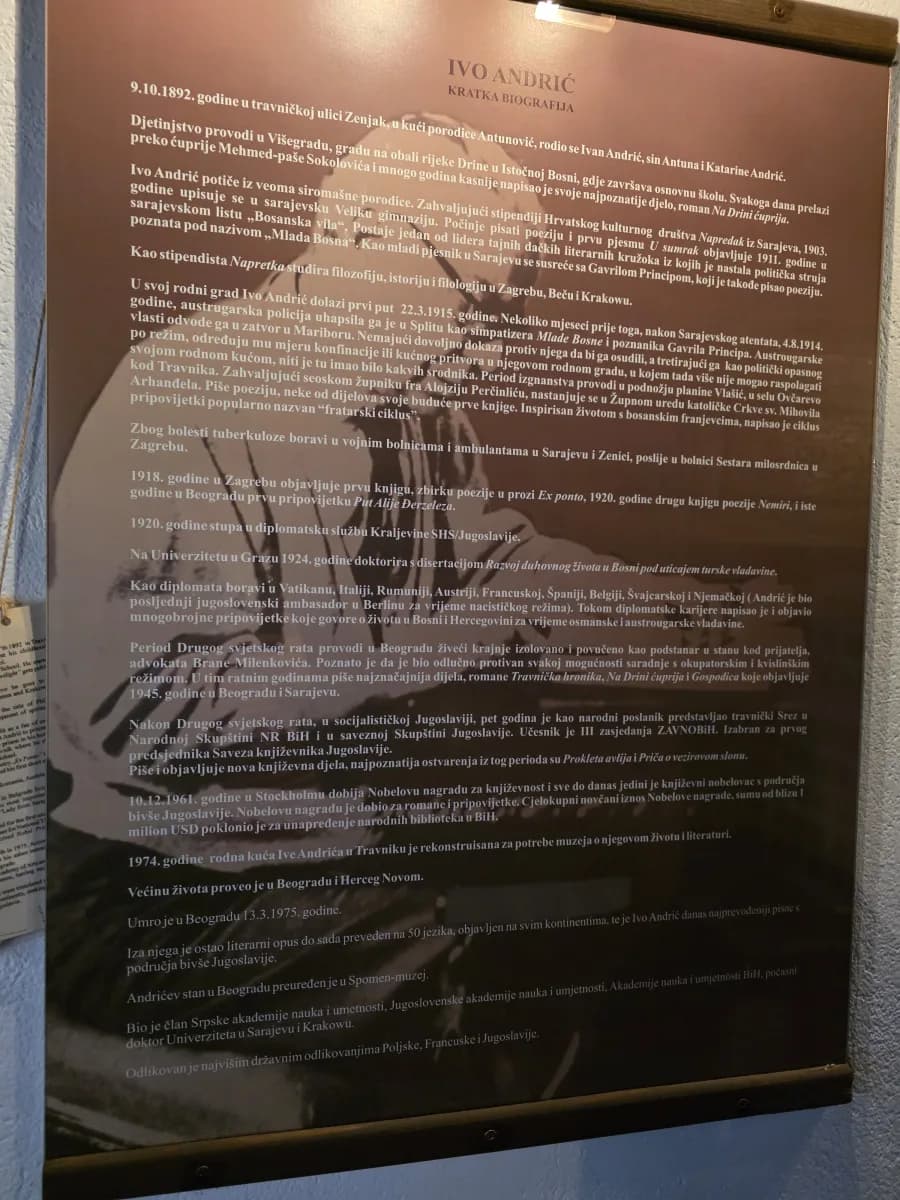
Andrić was born in 1892 in the Zenjak neighbourhood of Travnik. His birthplace still exists today, and after being reconstructed in 1974, it was opened as a Memorial Museum, just one year before his death. Born, by chance, in Travnik, where he spent the smallest part of his life, his path took him through Višegrad, Sarajevo, Zagreb, Vienna, Kraków and other cities, while a significant part of his working life was spent in the diplomatic service of the Kingdom of Yugoslavia.
He returned to literature regardless of his official positions and the historical circumstances of his time. From the places where he lived, he took cities, bridges, people and their stories, but transformed them into a literary world that long ago transcended the borders of a single region and a single era.
Although his life journey was not a simple one and in his youth he was strongly committed to the Yugoslav idea, in his mature years Andrić found his place within the Serbian national and cultural sphere. Serbian identity and Serbian literature became his chosen path, to which he belonged as a mature writer and in which he left one of the deepest literary marks.
In 1961, Andrić received the Nobel Prize in Literature, one of the highest honours a writer can receive, and to this day he remains the only writer from the territory of the former Yugoslavia to have received this prestigious recognition.
For Andrić, history is not merely a sequence of years and great events. It enters homes, families and the lives of ordinary people, changes cities, separates people, brings new rulers and leaves consequences even when those who suffer them have no ability to influence its course. Perhaps that is precisely why his books still do not feel like stories about a time that ended long ago.
Great Novels – History Through Human Lives
The Bridge on the Drina
If there is one book that has almost become synonymous with Andrić’s name, it is The Bridge on the Drina.
The novel follows the history of the bridge in Višegrad and the people who lived beside it for centuries. The Mehmed Paša Sokolović Bridge, built in the 16th century, stands at the centre of the story, but at the same time it is its quietest witness. Time passes, people come and go, while the stone arches remain.
Armies cross the bridge, rulers and borders change, new ideas and new ways of life arrive. People are born, fall in love, quarrel, suffer and disappear. The bridge remains to bear witness to everything that has passed.
That is one of the novel’s great strengths. Andrić does not tell history only through what can be found in textbooks. He brings it down among ordinary people and shows what great events mean to those who experience them.
The Travnik Chronicle
The Travnik Chronicle takes the reader to Bosnia at the beginning of the 19th century, during the Napoleonic Wars and a period of great upheaval across Europe.
French and Austrian consuls arrive in Travnik, bringing with them their ideas about a world that is unfamiliar to them. The diplomats’ encounters with the local community open up a whole range of questions about misunderstanding, prejudice, politics and different views of life.
Through their encounters, Andrić creates a portrait of Bosnia as a place where different worlds meet and collide. That is why The Travnik Chronicle is at once a historical novel and a story about people trying to understand one another, often with little success.
The Woman from Sarajevo
In the novel The Woman from Sarajevo, Andrić moves away from the broad historical panorama and focuses his attention on a single character—Rajka Radaković.
Following an experience that marked her youth, Rajka devotes her life to money and security. Saving money gradually ceases to be a means for her and becomes an end in itself. What was supposed to protect her from life’s uncertainties slowly separates her from people, intimacy and everything that makes life complete.
Through her fate, Andrić explores the fear of poverty, loneliness and attachment to material security. Beneath the story about money lies, in fact, the story of a person who, trying to protect life from risk, forgot how to live it.
The Damned Yard
The Damned Yard is one of Andrić’s most complete and complex works of prose.
The story is set in a prison in Constantinople, but the prison is much more than simply the setting. Different destinies, characters and stories intersect within it. Fra Petar, Karađoz and Ćamil remain at the heart of a story about power, suspicion, guilt and human helplessness in the face of a system.
A special place is given to Ćamil’s obsession with the fate of Djem Sultan. The story of a historical figure becomes the story of a man who recognises himself in another person’s fate.
Stories in Which Andrić May Be Most Himself
Andrić’s literary greatness does not rest on his novels alone. His short stories hold a special place, because within a brief form he knew how to “open” an entire world.
The Bridge on the Žepa is one of his best-known stories, in which the bridge is once again more than a structure. It is a trace of human labour and the desire to leave behind something that will outlast one’s own life.
In The Days of Anika, Andrić tells a story about society, morality, desire and the condemnation of the individual. Mara the Courtesan presents the story of a woman whose life is shaped by circumstances far greater than herself, while Mustafa Madžar opens a darker side of human nature, marked by violence and war. The story of The Peasant Siman explores dignity, power and the moment when a person can no longer accept humiliation.
And then there is Aska and the Wolf, a story that can be read as a fairy tale, but also as a parable about art. A little sheep dances in the face of death in order to gain time. In this simple, almost unreal situation, Andrić found one of his most universal themes: art as a way for human beings to confront fear and mortality.
There are also Jelena, the Woman Who Is Not There, The Story of the Vizier’s Elephant, The Journey of Alija Djerzelez and numerous other stories that demonstrate the remarkable breadth of his narrative range.
Signs by the Roadside – Andrić Without a Grand Plot
For readers who want to discover Andrić from a different perspective, there is Signs by the Roadside.
Published posthumously, this book brings together notes, thoughts, observations and brief reflections on people, loneliness, transience, art, fear, love and life.
This is not a book you have to read from beginning to end; it is a book you return to again and again. You return to it when you are looking for answers to certain questions, when life occupies your thoughts, or even when you find yourself without a suitable person to talk to. You open it at random, read a few pages and pause.
Sometimes a single sentence stays with you longer than an entire chapter.
In Signs by the Roadside, Andrić is no longer a chronicler of great historical events. Here, above all, he is an observer of the human being, of our thoughts and our quiet inner struggles. That is precisely why this book can be a beautiful first encounter with Andrić for those who are not yet ready to enter his great novels.
Andrić and Višegrad – When Literature Becomes Heritage
Višegrad holds a special place in Andrić’s literary work.
The town on the Drina has remained permanently connected with his name, above all thanks to the novel The Bridge on the Drina. The Mehmed Paša Sokolović Bridge, one of the most significant monuments of Ottoman architecture in Bosnia and Herzegovina, became through Andrić’s work one of the most recognisable symbols of the literary landscape of the Balkans.
In Andrić’s work, the bridge, the town and the kasaba are never merely places where the story takes place. They remember people, their lives and the changes they go through.
And that is precisely why Andrić’s heritage is preserved today not only between the covers of his books. It lives in libraries and archives, in the house where he was born, which reminds us of his life, but also in the places that, thanks to his work, have gained a special place on the literary map.
Perhaps this is what makes Andrić unique: his literature can be read as a story about people, but at the same time it can also be physically followed through the landscape. One can travel to Travnik, Višegrad, Sarajevo and other places connected with his life and literature, and then return to his books with the feeling that familiar passages suddenly have a different face.
The Nobel Prize – Recognition of the Literary World He Carried With Him
When he received the Nobel Prize in Literature in 1961, Andrić had already created a body of work that encompassed novels, short stories, essays and other literary forms.
The Nobel Prize was not an award for a single novel. It was recognition of his entire literary achievement and of the way in which, through historical themes, he spoke about universal human destinies.
