
At the top of Gučevo, above Banja Koviljača, a memorial ossuary dedicated to those who perished in the Battle of Gučevo has stood for almost a century.
Around it, among the forests and slopes, traces of the trenches can still be found.
Somewhat lower down stands a monument to Darja Korov(b)kina, a Russian nurse who came to Serbia as a volunteer and lost her life here while helping the wounded. Together, all of this forms an unusual memorial space, where history is not somewhere far away and behind glass.
It is here, in the stone, the earth and the forest.
You do not come to Gučevo only for the view
And the view is truly worth seeing.
From the mountain top, a wide panorama of the Drina Valley opens up, and when the weather is clear, the view stretches far across lands that are divided by borders today, but have been connected by the Drina for centuries.
Yet on Gučevo, people stop for another reason.
There is a feeling that the past is much closer here than in other places. It is enough to look towards the slopes and imagine that it was precisely here, more than a century ago, that people waited in trenches, not knowing what the next hour would bring.
The Battle of Gučevo was part of the Battle of the Drina and lasted from September to November 1914. Prolonged trench warfare was fought across difficult mountainous terrain, and Gučevo became known as the site of the “Battle Above the Clouds”.
Today, it is difficult to imagine Gučevo in the autumn of 1914. Instead of gunfire, there is the sound of the wind and rustling treetops. Instead of soldiers, hikers pass along the trails. Nature has long since reclaimed its place.
But the memorial ossuary at the top of the mountain reminds us that this peace was not always part of this landscape.
The Battle Above the Clouds – 55 Days in the Trenches
In the autumn of 1914, Gučevo became one of the most difficult places on the Serbian front. After the beginning of the second Austro-Hungarian offensive against Serbia on September 8, 1914, the fighting spread to this mountainous area as well.
Austro-Hungarian units initially managed to take control of Gučevo, but the Serbian army soon launched a counterattack.
Around September 26, Serbian troops reached Gučevo and, faced with a powerful enemy, began digging in in the immediate vicinity of the Austro-Hungarian positions.
Thus began trench warfare that would last for 55 days. Along a front approximately 17 kilometres long, soldiers lived practically underground.
In some places, the trenches came so close to one another that there were only five to seven metres between the Serbian and Austro-Hungarian positions.
This meant that enemy soldiers were almost within arm’s reach of one another. Such proximity was no coincidence.
The Austro-Hungarian army had considerably stronger artillery, so Serbian soldiers sought to dig in as close as possible to the enemy trenches. The closer they were, the more difficult it was for the artillery to fire on the enemy positions without risking hitting its own troops.
Thus, the mountain became a fortress made of earth, wood and stone.
For days and nights, soldiers remained in the trenches. Between them lay a space measured in metres, but in reality it represented the boundary between life and death.
In some positions, there were no major shifts in the front line. Instead of large-scale assaults, the war turned into a battle of attrition, artillery strikes, rifle fire and constant uncertainty.
For this reason, Gučevo remained remembered as one of the first major trench battles of the First World War.
And the name “Battle Above the Clouds” is no coincidence.
The mountain positions on Gučevo were often shrouded in fog and clouds, while the Drina Valley stretched out below them.
Over time, this expression became one of the most recognisable names for the fighting on Gučevo. The name was also preserved through the book Battle Above the Clouds – Cer, Gučevo, 1914 by Branimir Ginić, published in 1989.
But behind the poetic name lay a harsh reality. Particularly fierce fighting took place at Elevation 708, Eminove Vode and Kulište. The Serbian army suffered heavy losses on Gučevo, but through its prolonged resistance it managed to tie down Austro-Hungarian forces in that part of the front for almost two months.
Gučevo was lost, but the resistance was not in vain.
Fifty-five days on this mountain slowed and exhausted the Austro-Hungarian forces and became one of the chapters in the great suffering of the Serbian army during the Battle of the Drina.
That is why today, when we stand above the former trenches, it is difficult to remain merely an observer.
The forest has hidden many of the traces.
Time has done its work.
But the earth remembers.
And perhaps that is precisely why Gučevo is not simply a mountain with a beautiful view of the Drina. It is a place where one can understand how little it takes for only a few metres of earth to stand between two people—and for an entire war to lie between them.
A Monument Above the Trenches
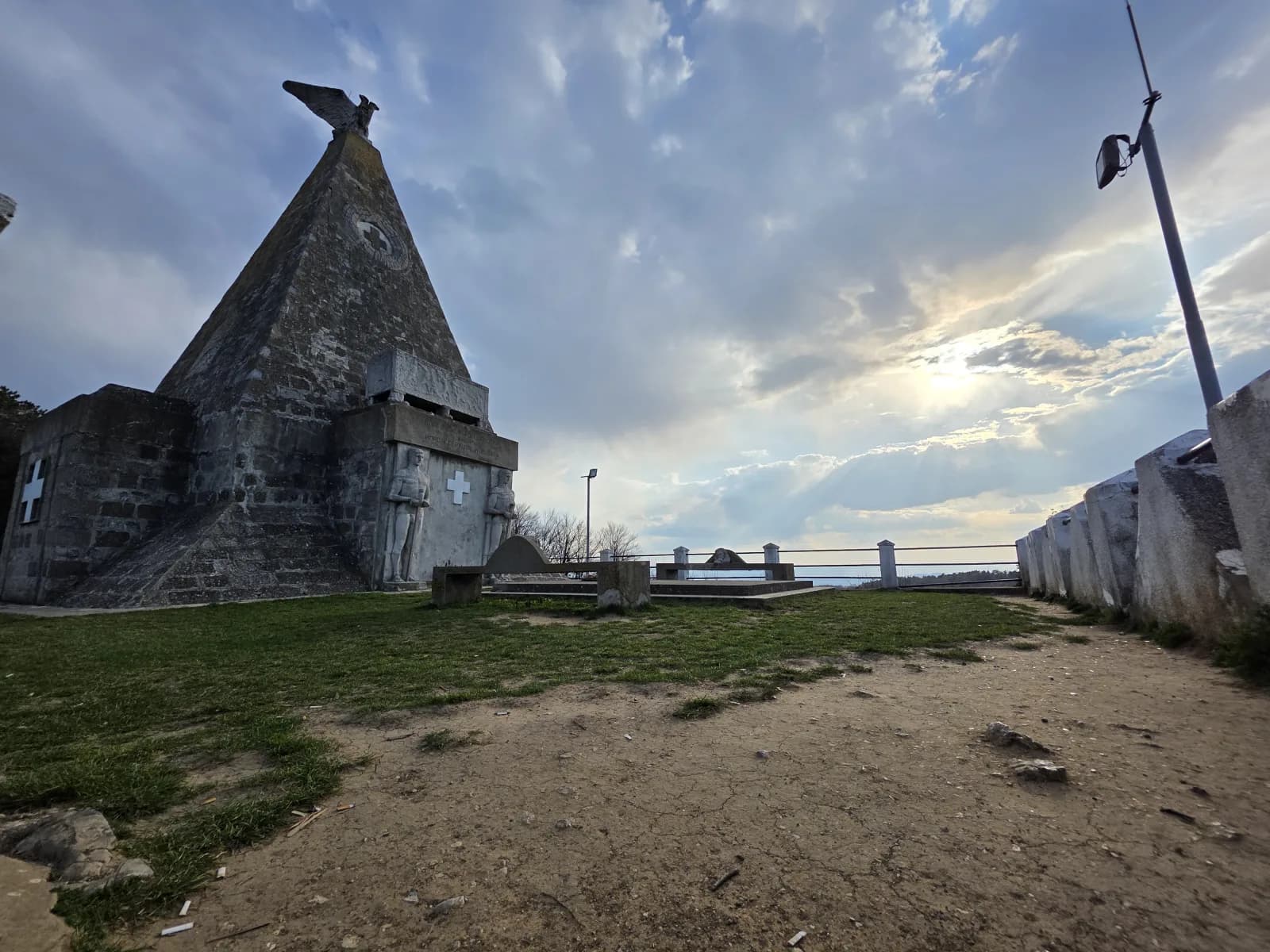
On one of the highest positions, a pyramid-shaped memorial ossuary was erected, standing almost 17 metres high.
At its top is a double-headed eagle made of white marble. The monument was completed in the late 1920s, and in 1929 it was erected by the Association of Reserve Officers and Warriors of the Kingdom of Yugoslavia.
The remains of Serbian and Austro-Hungarian soldiers who died in this area rest in the communal tomb.
Perhaps this very fact says more than anything about the time that has passed. Former enemies, wearing different uniforms and fighting under different flags, now rest in the same place.
War separated them.
Death returned them to the same earth.
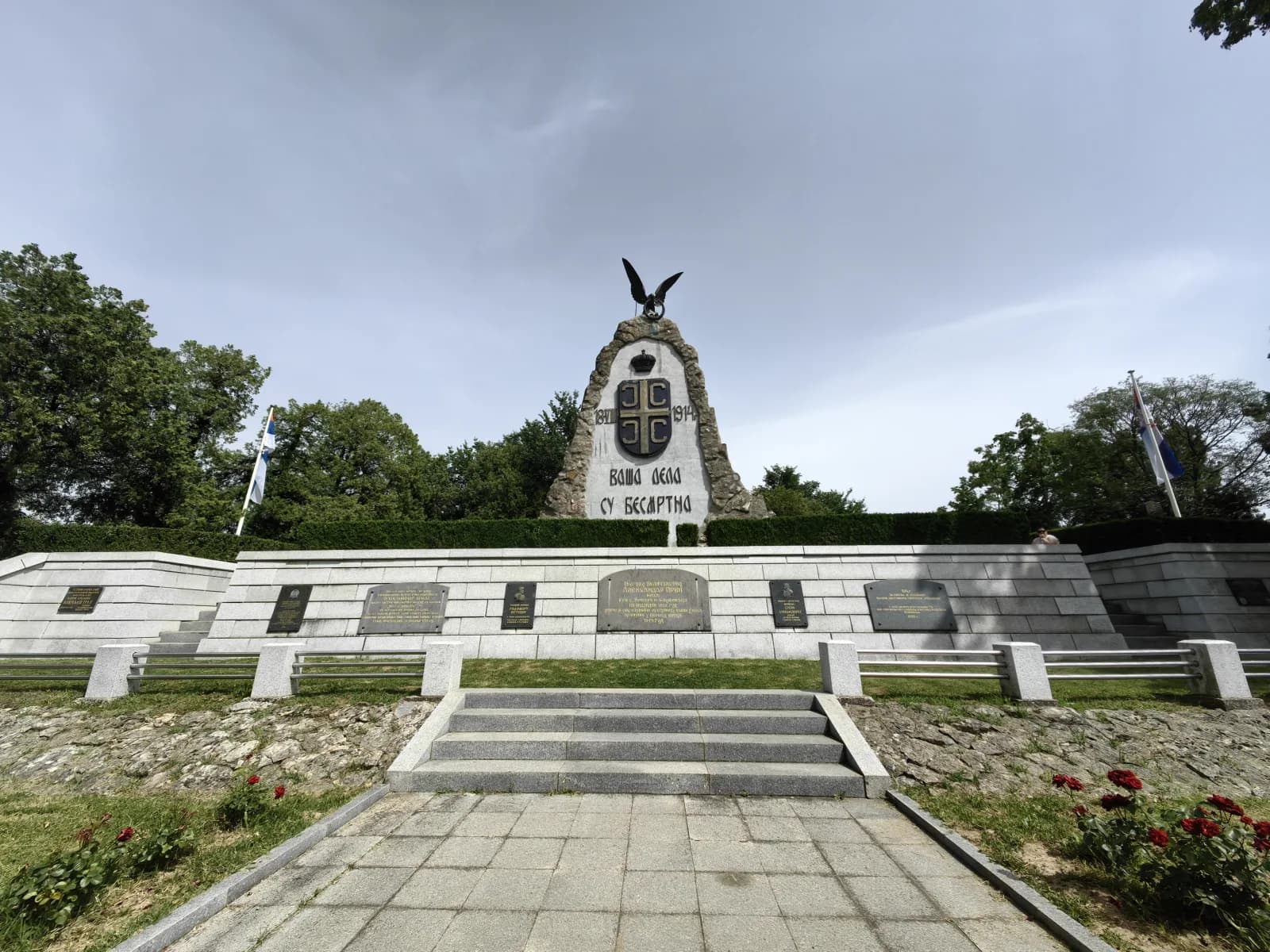
Words dedicated to the heroes of Gučevo are carved into the monument, and above them is a verse by Njegoš:
“Blessed is he who lives forever, for he had reason to be born.”
Before this monument, those words sound different than when we read them in a book. Perhaps because here we stand before real human lives, rather than a history lesson.
The Story of Darja
Gučevo, however, preserves more than the memory of soldiers.
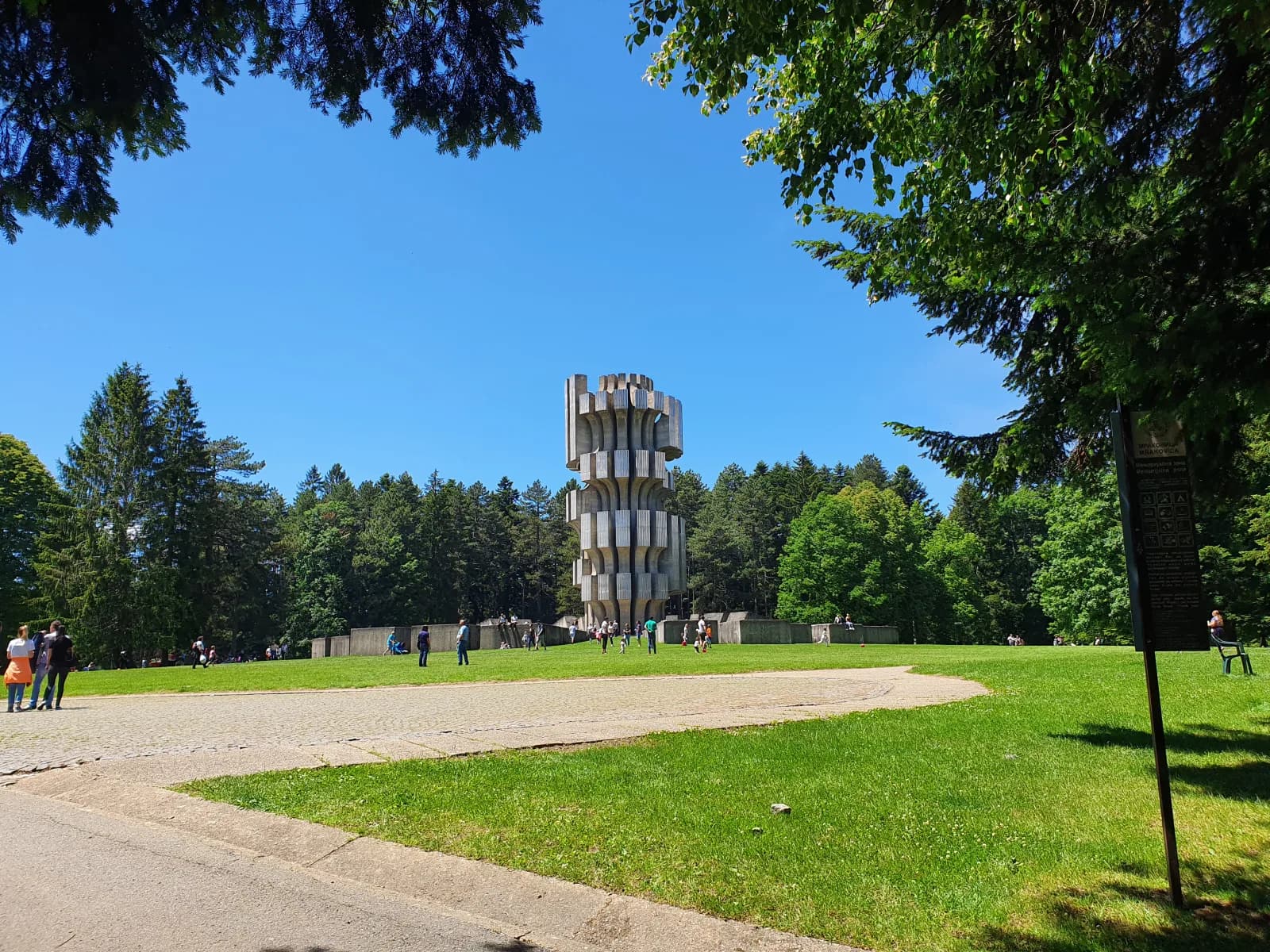
Not far from the memorial ossuary stands a monument to Darja Aleksandrovna Korov(b)kina, a Russian nurse who came to Serbia in 1914 as a volunteer and joined those helping the wounded.
Her story is quieter than the wartime stories we usually remember. Darja did not come to fight. She came to heal. At a time when war was determining the fate of entire nations, she chose to be where the wounded and helpless were. And that is where she remained.
Perhaps that is precisely why her story still touches people today.
More than a century later, her name has once again found its place on Gučevo.
The monument to Darja Korov(b)kina was unveiled in 2018. It was created by academician and artist Dragoljub Drago Mirković, who donated it to Loznica and Serbia. There is a special beauty in this gesture. An artist’s work became a gift to the community and a memorial that will remain for generations to come. Thus, two memories came together on Gučevo: the memory of thousands who perished in the Great War and the memory of a woman who, far from her home, came to help others.
Heritage That Is More Than Stone
Today, Gučevo is a picnic area, a mountain, a viewpoint and a place where people come to breathe fresh air, take a walk and look towards the Drina. But, as we have already emphasised several times, Gučevo is much more than a beautiful view. Here, nature and history meet. The forest preserves traces of the trenches, stone preserves names, and stories preserve what cannot be seen with the naked eye. That is why a visit to Gučevo perhaps should not be an ordinary excursion.
It is worth stopping.
Looking at the monument.
Walking to the remains of the trenches.
Looking towards the Drina and trying to imagine the people who stood in that very place more than a century ago. Because heritage is not merely an old structure that we photograph before moving on. Heritage is memory. And memory survives only if someone passes it on.
On Gučevo, that story is still being told.
In the stone of the memorial ossuary. In the traces of the trenches. In the name of Darja Korov(b)kina. In the view towards the Drina.
And perhaps that is why this mountain is best discovered slowly. Without rushing, because some mountains should not simply be visited—they should be listened to.